

TWC Career School Audit Cost and Timeline: What to Expect


The TWC career school audit cost and completion timeline depend on what is actually on the school’s balance sheet, how complete the accounting records are, and how quickly management can answer questions. A newly formed, cash-funded school may be relatively straightforward. A school with operating activity, equipment, debt, leases, payroll, related parties, or accounting cleanup usually requires more work.
There is no responsible one-price or one-timeline answer for every applicant. The best quote comes from matching the audit scope to the applicant’s legal entity, financial-statement date, balances, activity, records, and intended TWC submission date.
What Determines TWC Career School Audit Cost?
Audit fees are driven by the work necessary to obtain sufficient appropriate audit evidence—not simply by the number of pages in the financial statements. Important factors include:
The school’s legal structure and reporting entity
Whether the school is new, pre-opening, or already operating
The number and complexity of accounts and transactions
Whether the books are complete, reconciled, and prepared under GAAP
Cash accounts, equipment, leases, debt, payroll, receivables, payables, and deferred revenue
Owner contributions, owner loans, donations, grants, and related-party activity
The quality and availability of supporting documents
Whether accounting adjustments or cleanup are needed
The requested completion date and management’s response time
The auditor should understand these facts before proposing a fee. A quote based only on “I need a TWC audit” may omit important scope considerations.
What If the School Only Has Cash From Owner Contributions?
A small startup is not too simple to serve. A newly formed school may have only a bank account funded by an owner contribution and a few formation or startup expenses. Its balance sheet might show cash of $50,000, no liabilities, and owner equity of $50,000.
That simplicity can reduce the volume of audit work, but an audit is more than confirming a bank balance. The CPA may still need to address:
The applicant entity’s legal existence and ownership
Whether the bank account belongs to the applicant
The source, date, and classification of deposited funds
Whether the funding is an equity contribution or a repayable owner loan
Whether the owner personally paid costs that should be recorded
Whether liabilities, commitments, or subsequent disbursements were omitted
Whether the financial statements follow GAAP
Management’s responsibility for the statements and representations
Simple records often make the engagement more efficient. They do not eliminate professional standards, documentation, independence, quality control, or the procedures necessary to support the auditor’s opinion.
Why More Activity Usually Means More Audit Work
As the school grows, the CPA may need to audit additional balances and transactions.
Examples include:
Equipment and leasehold improvements
The school may need invoices, proof of payment, placed-in-service information, depreciation records, ownership evidence, and support distinguishing assets from expenses.
Debt and leases
Loan agreements, lender statements, amortization schedules, lease contracts, current maturities, accrued interest, and classification under GAAP may require evaluation.
Tuition and student activity
An operating school may have receivables, refunds, deposits, deferred revenue, cancellations, or obligations to students. The CPA must understand the underlying activity and test relevant assertions.
Payroll and vendors
Payroll reports, tax filings, contractor payments, accounts payable, and unrecorded liabilities add populations and cutoff considerations.
Related parties and founder-paid costs
Transactions with owners, officers, relatives, affiliated entities, or personally paid expenses require clear identification, support, accounting, and potentially disclosure.
An Audit Quote Is Not the Same as a Bookkeeping Quote
Management is responsible for the school’s accounting records and financial statements. An auditor must remain independent. If the books are incomplete, the school may need bookkeeping or accounting assistance before the audit can proceed.
In some circumstances, the audit firm may be able to provide limited nonattest assistance while maintaining independence, provided management accepts its responsibilities. In other situations, the school may need a separate bookkeeper or accountant. Prospects should disclose the condition of the records before accepting an audit proposal so the parties can distinguish:
Pre-audit bookkeeping or cleanup
Financial-statement preparation assistance, if permissible
The independent audit itself
TWC application assistance outside the audit
Keeping those services and responsibilities clear helps prevent unexpected fees and delays.
How Long Does a TWC Career School Audit Take?
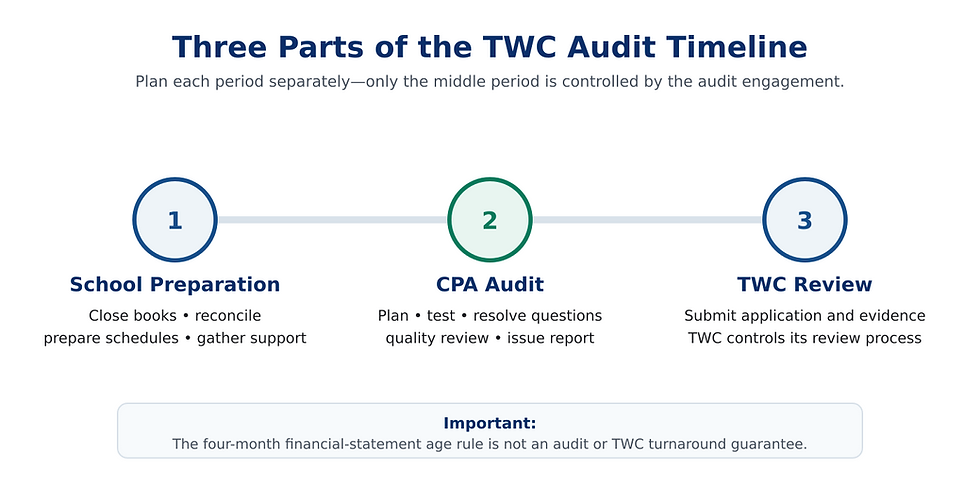
The calendar includes more than the days the CPA spends testing. A realistic plan has three separate periods:
School preparation. Management closes the books, reconciles accounts, prepares schedules, and gathers support.
CPA audit. The auditor plans the engagement, performs procedures, resolves questions, evaluates adjustments, completes quality review, and issues the report.
TWC review. After submission, TWC evaluates the application and financial evidence under its own process. The CPA does not control that review period.
A well-prepared, cash-only startup may move faster than an operating school with multiple accounts and unresolved issues. Any estimated delivery date should be conditioned on receiving complete records, signed engagement documents, requested confirmations, management responses, and other support on time.
The Financial-Statement Date Matters
For a new-school application, current TWC financial-stability instructions should be reviewed before choosing the financial-statement date. TWC Form CSC-016 states that the financial statements generally must be no more than four months old when submitted with the original application.
That rule makes timing important. A school should not select a balance-sheet date, schedule the audit, and wait indefinitely to assemble the rest of the application. If the submission slips too far, the school may need updated financial information or other work.
Confirm the current form and requirements with TWC for the school’s facts. The four-month rule relates to the age of the financial statements at submission; it is not a promise that the CPA will finish in four months or that TWC will approve the application within four months.
Common Causes of Additional Fees or Delays
Bank accounts are not reconciled to the financial-statement date.
The trial balance changes after audit work begins.
Owner deposits are not identified as contributions or loans.
Startup expenses paid personally have not been recorded.
Debt balances do not agree to lender statements.
Current portions of long-term debt are not calculated.
Invoices, contracts, lease agreements, or proof of payment are missing.
Accounts payable and accrued expenses are incomplete.
The applicant entity’s records are mixed with another business or an owner’s personal activity.
Management is unavailable to answer questions or approve adjustments.
The requested deadline changes after the engagement begins.
The best cost-control strategy is not to reduce necessary audit procedures. It is to begin with complete, accurate, well-supported records and a realistic schedule.
When Should the School Engage the CPA?
Contact the CPA before the desired submission date and, ideally, before locking in the financial-statement date. Early discussion allows the CPA and school to identify:
The entity that will apply to TWC
The likely financial submission required
Whether the school is truly audit-ready
The proposed balance-sheet date
The documents and schedules management must prepare
Dependencies involving legal formation, funding, leases, or other application materials
A target schedule with appropriate contingency time
An inquiry made days before a filing goal may not leave enough time for preparation, audit fieldwork, management follow-up, quality review, and report issuance.
What to Provide When Requesting a Quote
The following information helps a CPA provide a more reliable proposal:
Legal name, entity type, formation date, and ownership
Whether the school has begun operations or enrolled students
Intended TWC submission date and proposed financial-statement date
Current balance sheet and year-to-date profit and loss statement, if available
General ledger or a description of the number of transactions
Bank accounts and most recent reconciliations
A list of equipment, loans, leases, payroll, receivables, payables, and related parties
The source and classification of startup funding
Whether the books require cleanup or GAAP adjustments
Whether another CPA or accountant has worked on the records
A cash-only startup should say so. It may not have every report on the list, and that is acceptable. The goal is an accurate picture of what exists—not a large document package for its own sake.
Frequently Asked Questions
How much does a TWC career school audit cost?
The fee depends on the entity, balances, transactions, record quality, audit readiness, timing, and other engagement facts. A CPA should review enough information to understand the scope before quoting a fixed fee or range.
Is a cash-only startup less expensive to audit?
It may require less work than an operating school with multiple accounts and transactions. However, the auditor must still satisfy professional standards and address formation, cash, funding, completeness, GAAP presentation, and management representations.
Can the CPA finish the audit in a few days?
Do not assume so. Availability, record readiness, confirmations, identified issues, management response time, and quality review all affect completion. Ask for a schedule based on the school’s actual facts.
Does the four-month rule mean I have four months to finish the audit?
No. The current new-school form generally limits how old the financial statements may be when submitted. It does not establish the auditor’s turnaround time or TWC’s review time.
Will a clean audit opinion guarantee TWC approval?
No. The audit opinion addresses the financial statements under the applicable reporting framework. TWC separately evaluates financial stability and the other application requirements.
Can cleanup and the audit happen at the same time?
Sometimes limited assistance may be permissible, but management remains responsible and the auditor must maintain independence. Significant bookkeeping may need to be completed before audit testing or by a separate provider
What is the fastest way to avoid delays?
Engage early, freeze the final trial balance, reconcile every account, identify contributions and loans, record all liabilities, organize support, and respond promptly to requests.
How JConner Can Help
JConner assists Texas career-school applicants with audit readiness, audited financial statements, financial-stability analysis, accounting cleanup planning, and related advisory services. We work with both cash-funded startups and schools with more developed operations.
Tell us your entity type, whether the school has begun operating, what is on the balance sheet, the proposed financial-statement date, and when you hope to submit the application.
Related TWC Career School Guides
Official Resource
Last reviewed: July 22, 2026. This article provides general information based on guidance available as of that date. Requirements, forms, and processing practices may change. Engagement fees and timelines depend on the school’s facts and do not guarantee TWC approval. This is not legal advice.


Comments