

Does Your Texas Career School Need a TWC Balance Sheet Audit?

Updated: Jul 22

Starting a Texas career school often requires proving to the Texas Workforce Commission (TWC) that the school is financially stable. For many applicants, that means submitting a balance sheet audited by an independent CPA firm—but the required level of service depends on how the school is owned.
A review, compilation and audit are not interchangeable. Engaging a CPA for the wrong service can delay the Certificate of Approval application and create additional cost. Before beginning the engagement, the school owner and CPA should confirm the ownership structure, reporting entity and current requirements in TWC Form CSC-016.
This article explains who generally needs a TWC balance sheet audit, the different requirement for an unorganized sole proprietor and why the audit date should be coordinated with the application timeline.
Who Needs a TWC Balance Sheet Audit?
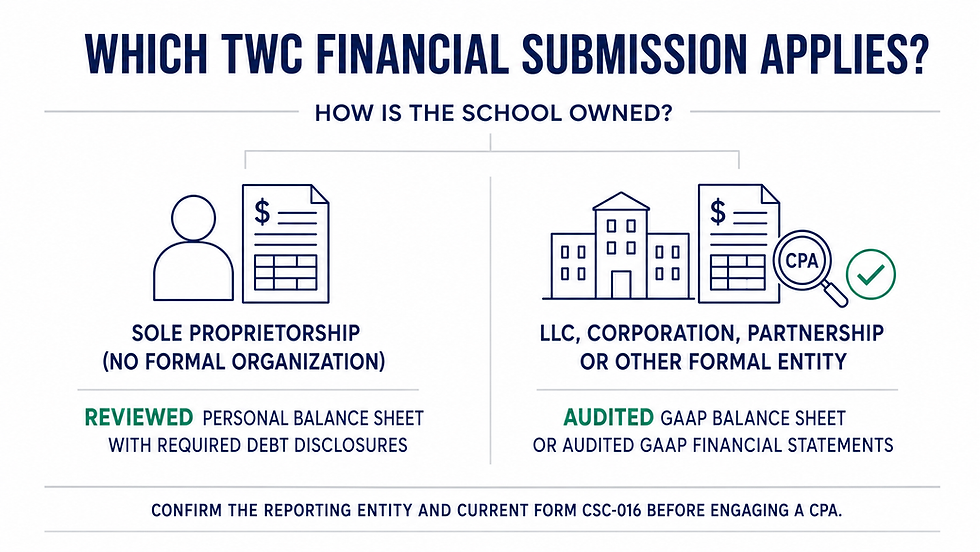
Under the current version of TWC Form CSC-016, a school owned through an LLC, corporation, partnership or other formal ownership structure generally must submit one of the following:
A balance sheet audited under generally accepted auditing standards (GAAS) and prepared in conformity with U.S. generally accepted accounting principles (GAAP); or
A complete set of financial statements audited under GAAS and prepared in conformity with GAAP.
An individual operating as a sole proprietor without a formal organization generally follows a different route. The form calls for a reviewed personal balance sheet, including notes that disclose the payments required under debt agreements for each of the next five years.
The distinction is important: an LLC with one owner is still a formal legal entity. It should not be treated as an unorganized sole proprietorship merely because it has a single member or is disregarded for federal income-tax purposes.
Why Ownership Structure Controls the Submission
The financial submission is intended to demonstrate the financial position of the person or entity responsible for operating the school and fulfilling its obligations to students.
For an individual operating without a formal organization, TWC generally looks to the individual owner's reviewed personal balance sheet. For a school operated through a formal entity, TWC generally requires audited financial information for the applicable business entity.
This can become more complicated when:
The school operates as a division of an existing company;
A corporation operates multiple schools or business lines;
The facility or equipment is owned by a related party;
Another company paid the school's startup expenses; or
The owner formed multiple entities for the school, real estate and operations.
Form CSC-016 states that corporate submissions must be consolidated financial statements for the entire corporation, including all divisions. Applicants should not assume that a balance sheet prepared only for a new location or internal school division will satisfy the requirement.
Audit, Review and Compilation Are Different Services
The terms audit, review and compilation describe different CPA services and different levels of assurance.
Audit
An audit provides reasonable assurance and results in an auditor's opinion on whether the financial statements are presented fairly, in all material respects, in accordance with the applicable financial-reporting framework. Audit procedures may include external confirmations, inspection of supporting documents, testing transactions and balances, evaluation of accounting estimates, and consideration of financial-statement presentation and disclosures.
Review
A review provides limited assurance, primarily through analytical procedures and inquiries. It is substantially narrower than an audit. Under CSC-016, the reviewed personal-balance-sheet route generally applies to a sole proprietor operating without a formal organization—not automatically to an LLC, corporation or partnership.
Compilation
In a compilation, the CPA assists management with presenting financial information but does not obtain or provide assurance on that information. A compilation should not be assumed to satisfy the initial audit requirement for a formally organized school owner.
What Must the Audited Balance Sheet Demonstrate?
The CPA's audit opinion and TWC's financial-stability determination are separate. The CPA reports on whether the balance sheet is fairly presented under GAAP. TWC evaluates whether the amounts reported satisfy its regulatory criteria.
The current CSC-016 form states that the balance sheet must reflect:
Positive equity or net worth;
A current ratio of at least one-to-one;
Equity or net worth greater than reported goodwill, if goodwill is applicable; and
No past-due liabilities.
A school can receive an unmodified audit opinion and still fail a TWC financial-stability test. For example, a GAAP balance sheet may be fairly presented while showing negative equity or current liabilities greater than current assets.
School owners should evaluate these conditions before selecting the final balance-sheet date. The auditor cannot change completed transactions simply to make the school satisfy a regulatory ratio.
Does the School Need a Balance Sheet Audit or a Full Financial Statement Audit?
CSC-016 permits formal entities to submit either an audited balance sheet or audited financial statements. A balance sheet audit focuses on financial position as of a specific date. A complete set of financial statements generally also includes statements addressing results of operations, cash flows and changes in equity, along with the related notes.
For a newly formed school with limited operating activity, a balance sheet audit may be the more focused option. However, the appropriate engagement depends on the entity's activity, reporting needs and whether another party requires complete financial statements.
The school should discuss the options with its CPA before the engagement letter is signed. Choosing a balance sheet audit for TWC does not necessarily satisfy the requirements of a lender, investor, accreditor or federal funding program.
The Four-Month Timing Rule
For initial submissions, Form CSC-016 generally requires the balance sheet or financial statements to be submitted within four months of the statement date. If more than four months have elapsed, the form states that the applicant must also provide financial information for a more recent period—compiled, reviewed or audited by a CPA firm—as described in the form.
This means the school should coordinate:
Completion of its bookkeeping and reconciliations;
The target balance-sheet date;
CPA audit fieldwork;
Completion of the remaining TWC application materials; and
The anticipated application submission date.
Obtaining the audit too early can cause the financial statements to become stale while the school completes its catalog, program applications, staffing documents or facility preparations. Waiting until the rest of the application is finished can also create delays if the accounting records are not ready for audit.
What Should Be Ready Before the CPA Begins?
At a minimum, a formal entity should be prepared to provide:
Formation and governing documents;
Ownership and related-party information;
A finalized trial balance and general ledger;
Bank statements and completed reconciliations;
Support for capital contributions and owner loans;
Accounts payable and accrued-liability schedules;
Loan agreements and debt schedules;
Facility and equipment leases;
Support for equipment and other assets; and
Documentation for significant startup transactions.
Personal and business transactions should be separated. Funds provided by an owner should be clearly documented as equity or debt, and the accounting records should include all obligations existing as of the audit date.
Are There Any Exceptions?
CSC-016 describes a limited submission for an owner who already holds a Certificate of Approval for another school and for whom TWC has received acceptable financial statements. In that circumstance, the form indicates that certain projections and the required true-and-correct statement may be submitted instead.
Applicants should not assume the exception applies. Confirm eligibility with TWC and document that acceptable financial information for the other school is already on file.
When Should You Contact a CPA?
Contact a CPA before choosing the audit date or finalizing the financial section of the application. Early planning can help determine:
Whether the ownership structure requires an audit or review;
Which person or entity is the financial-reporting entity;
Whether a balance sheet audit or full financial statement audit is appropriate;
Whether the accounting records are audit-ready;
Whether the financial position appears to meet TWC's criteria; and
How the audit date should align with the expected application date.
For a broader explanation of the application, financial-stability tests and ongoing reporting responsibilities, read our TWC Career School Approval and Audit Guide.
How JConner Can Help
JConner provides independent audit and audit-readiness services for prospective Texas career schools. Our work can include assessing the condition of the accounting records, identifying documentation and GAAP issues, coordinating the balance-sheet date with the application timeline, and performing the required independent audit.
If you are preparing a TWC Certificate of Approval application, contact JConner before selecting the reporting date. A planning discussion can help identify the correct engagement and the records needed to begin.
Last reviewed: July 18, 2026. This guide is provided for general informational purposes and reflects TWC information available as of that date. TWC forms, fees and rules may change. Applicants should confirm current requirements with TWC before filing. This information is not legal advice and does not guarantee approval of an application.

Comments